
Qigong
Qigong is a practice of cultivating awareness, breath, movement, and the energy that animates us.
Through gentle movements, breath, and focused awareness, qigong helps settle the nervous system, quiet the mind, and reconnect us with the natural wisdom of the body.
Qigong
Qigong (pronounced “chee gong”) has many spellings because of different translation systems. Like tai chi and taiji, these are different ways of writing the same practice.
We experience energy (qi) every day. Food nourishes us. Water sustains us. Breath keeps us alive. Relationships can either renew us or leave us depleted. Qigong explores this deeper understanding of energy and how we cultivate harmony within ourselves.
That's all qi.
Qigong is a great tool to help bring us back into harmony, balance. It teaches us to use the tools we have (body, mind, emotions) as advisors. We listen to them so that we can live more fully from the steady center of who we are.
Qigong helps:
- Quiet the body, breath, and mind so we can sense what is happening within us.
- Come back to Essence, our steady center beneath the noise.
- Meet the world from that center, rather than being pulled around by everything happening within and around us.
I want to learn Qigong!
There are two ways to explore Qigong with Shift With Lucy:
Online Learning
Become a member of Shift With Lucy and access Qigong, Taiji, Meditation, and select workshops and classes through the online community. You can practice at your own pace and revisit the courses whenever you like.
Live Zoom Classes
Join me for live 5-week Qigong sessions where we practice together, explore the principles of Qigong, and develop a deeper understanding of the body, breath, and energy through movement.

Qigong or Taiji?
Well, you might ask, what's the difference?
Great question.
Yes, both practices cultivate awareness, movement, and qi. But the way we approach them is different.
Qigong
I teach a simple form of Qigong called Baduanjin. It is a physically accessible practice that allows us to explore breath, movement, and the subtle sensations of the energy body without having to learn a complex sequence of movements to memorize.
The focus is less on perfecting a form and more on sensing what is happening within us.
Taiji
The form of Taiji I teach, Guang Ping Yang Taijiquan, and Taiji For Balance are much more nuanced and physically complex. It takes time to develop familiarity with the movements before we can fully explore their subtler qualities.
That complexity offers a rich physical practice, developing coordination, proprioception, balance, memory, and awareness while also cultivating qi.
Both are lifelong practices.
Qigong can offer a more immediate doorway into sensing and cultivating qi. Taiji asks us to stay with a more complex physical language over time. Neither has an endpoint. Both continue to reveal something new as we practice.
Monthly Membership
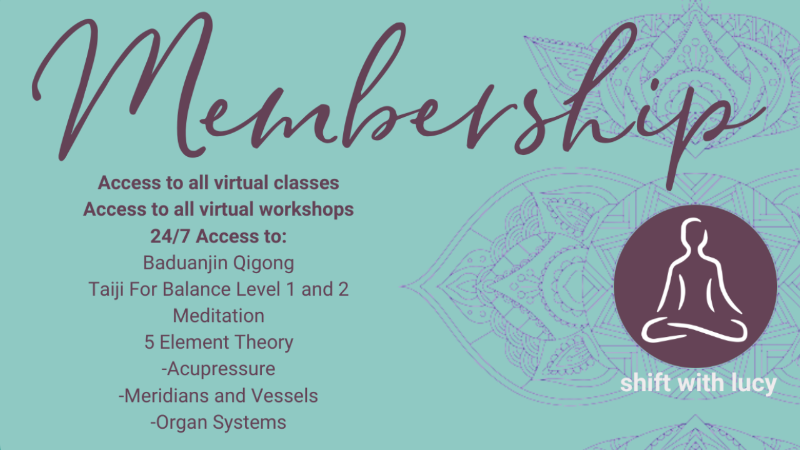
24 hour Daily Access | $39/month | Virtual weekly classes included
Open to all levels of experience
When I moved my teaching from my brick-and-mortar studio into an online space, I discovered something unexpected: students could continue learning deeply while having the flexibility to practice at their own pace.
The online community became a place to revisit teachings, explore details, and continue practicing together beyond our live sessions. Having the ability to return to a lesson, pause, rewind, and practice again turned out to be especially valuable for learning practices that take time to understand and embody.
A monthly membership gives you access to Taiji For Balance Levels 1 and 2, Baduanjin Qigong, meditation practices, select workshop recordings, and future courses and teachings.
These aren't simply collections of exercise videos. Each course includes 30–60 lessons with presentations that explore concepts, history, and the principles behind the practices. You'll find detailed instruction alongside the physical practice, giving you the opportunity to understand not only what you're doing, but why you're doing it.
The movement practices include videos recorded from several different angles to help you see and understand body mechanics with greater clarity and precision. You can slow down, revisit a movement, and practice as many times as you need. This is particularly helpful with Taiji and Qigong, where awareness develops through repetition and attention rather than simply getting through a sequence.
Meditation practices are woven into the learning as well. These meditations support the physical practices while giving you another way to settle the body, quiet the mind, and become more aware of your internal experience.
Each course also includes detailed PDFs and supporting presentations. The PDFs are printable, so you can take notes or carry them with you when you're practicing away from your computer or internet connection. The presentations offer another layer of learning, connecting Taiji, Qigong, meditation, and the Five Elements to the experience of being human and to the choices we make in everyday life.
The online format also gives you something a live class can't always provide: time. You don't have to absorb everything in one session. You can return to a lesson weeks or months later and often discover something you weren't ready to notice the first time.
If you’re curious about exploring these practices, you’re welcome to try the membership free for 30 days. You won’t be charged unless you decide to continue.
Sensing Qi
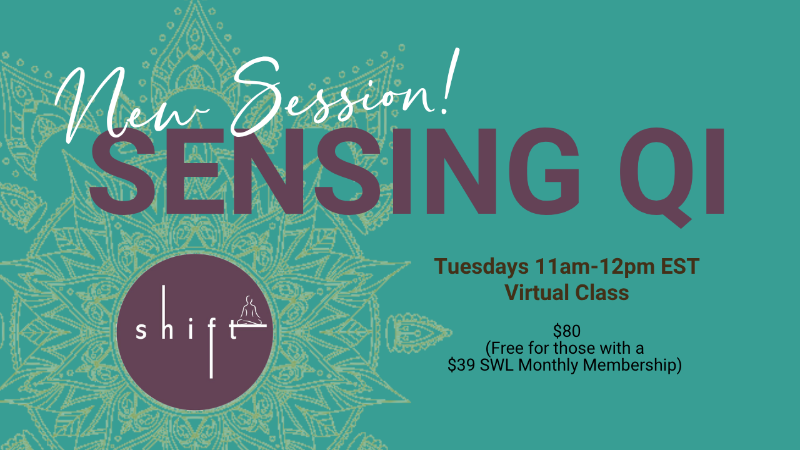
Tuesdays, October 27 - November 24
11 AM –12 PM EST | $80 | Online
(Free to those with a SWL Monthly Membership - Use MEMBER only links sent via email)
Open to all levels of experience
This session of Sensing Qi explores the energy in the simplified postures of Taiji For Balance. This isn't about perfecting movement, but about how the postures can create space for qi to develop and influence the spirit of us to be more anchored and less activated in life.
Strike Palm, the first movement in the series, is a posture of creating, owning, and being the keeper of your own space. This is deeply energetic because it allows us to look at how can compress and where we make ourselves small not allowing ourselves the energy we need. Or where take up space and become bigger than necessary, wasting energy.
Grasp Bird's Tail, is especially powerful for taking care of our space. For knowing what to pick up, what to let go, what to pause and ponder, and how to maintain the qi flow during it all. It teaches us to refine, slow down, enjoy. Rather than chase every sparkly object, scattering our qi.
These have deep anchors in the 5 Elements where we can embody, for instance, the Earth Element in owning our space in the world, understanding scarcity issues, digesting what we are experiencing.
Or the Metal Element, which helps us parse through and hold the gems of what we find while letting go of the dross of life - especially those things that no longer serve us, but we feel timid about letting go...
Through this practice we create conditions where qi can flow.
On top of moving through simplified postures, you will learn and review:
Essence. Essence is our sage center - the quiet place where we witness and respond in life, maintaining our qi and our longevity. Essence, as part of the taiji form, is the center line, the vertical core of energy that runs through our center lifting us and anchoring us.
The Three Advisors. The 3 energy fields (dantians) use qi for thinking (upper dantian), emoting (middle dantian), and physically doing (lower dantian). When moving from our sage center, Essence, we find ourselves more able to store and use qi with sparing efficiency. Being in Essence and less in the mental, emotional, and physical swirl of life creates a calm presence and inner harmony.
Breathwork. Breathing, our respiratory system, is our access to supporting all of the other systems in the body. Through the breath, we can help calm the nervous system; assist in regulating blood pressure, heart rate (cardiovascular system); create a better environment for assimilation (digestive system); which in turn affects our endocrine (hormonal) system. Breathing, along with centering in Essence are key factors in reducing qi stagnation in the body.
Have questions? Feel free to email me, or contact me as a member of our free community!
Ready to sign up? Click Learn More below and register!
Qi of Taiji
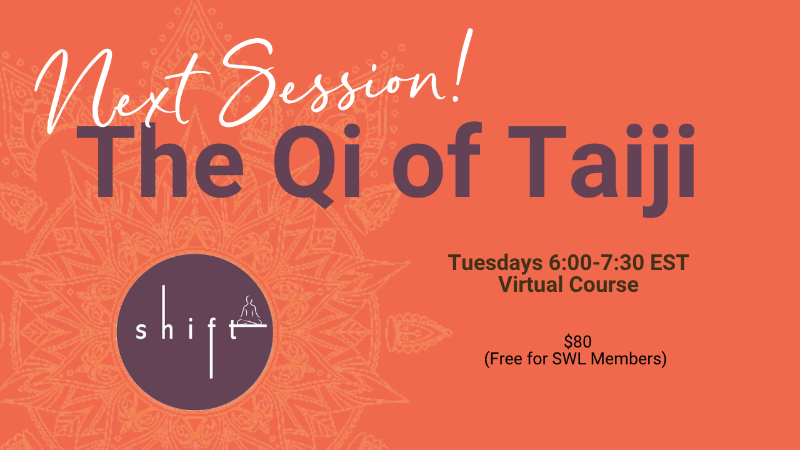
Tuesdays, October 27 - November 24
| 6:00–7:30 pm | $80 | Virtual Class
(Free to those with a SWL Monthly Membership - Use MEMBER only links sent via email)
Open to all levels of experience
An embodied exploration of presence, perception, and the subtle intelligence that lives beneath form—through the slow, attentive practice of taiji.
Qi of Taiji explores the fluid movements of taiji as a living practice—one that slowly, almost imperceptibly, moves into other areas of life. Like osmosis, the work softens what has become rigid and invites life to move with a little more ease.
Rooted in ancient movements originally developed for self-defense, this practice is less about combat and more about orientation. Through slow, sustained movement, you learn how to find and return to a tethered center—even when conditions feel stormy. Qi is cultivated not through effort, but through attention, patience, and relationship, allowing steadiness to emerge rather than be forced.
This practice includes warmups, targeted exercises to embody principles, time to explore sensing qi, posture repetition, time for questions, and it ends practicing the Guang Ping Yang Taijiquan set.
No prior taiji experience is required—only a willingness to move slowly, pay attention, and explore what lives beneath the surface of form.
For those who have been studying with me, we are going over the following movements (if time and practice allows!):
Turn, Kick Two Feet Upward
Deflect, Parry, and Punch
Step Back, Arms Beside Body
But we will always make room for pausing, reviewing, asking and answering questions - and exploring the principles of our form, which include basic body mechanics, song (deep relaxation which includes much more than the body), whole body movement, internal and external harmonies, to name a few.
For those who are new to the practice, or returning for a refresher, you will begin with the first postures of Guang Ping Yang Taijiquan. We always make room for questions, answers, pauses, and weekly review along with our warmups, and special focuses for the week.
Strike Palm to Ask Buddha
Grasp Bird's Tail
Single Whip
White Stork Cools Its Wings (Part 1)
Not only are class recordings available, but separate videos are offered repeating single movements (in silence to simply feel the movement) but I also offer videos of the repeated practice up to the point you have learned, so that you are able to practice the movements getting a better understanding of the entire flow.
I have heard from many students how invaluable these avenues of support between classes are. When questions arise, they are always able to go back and remind themselves, or practice along with me in the background.
Have questions? Feel free to email me, or contact me as a member of our free community!
Ready to sign up? Click Learn More below and register!
